
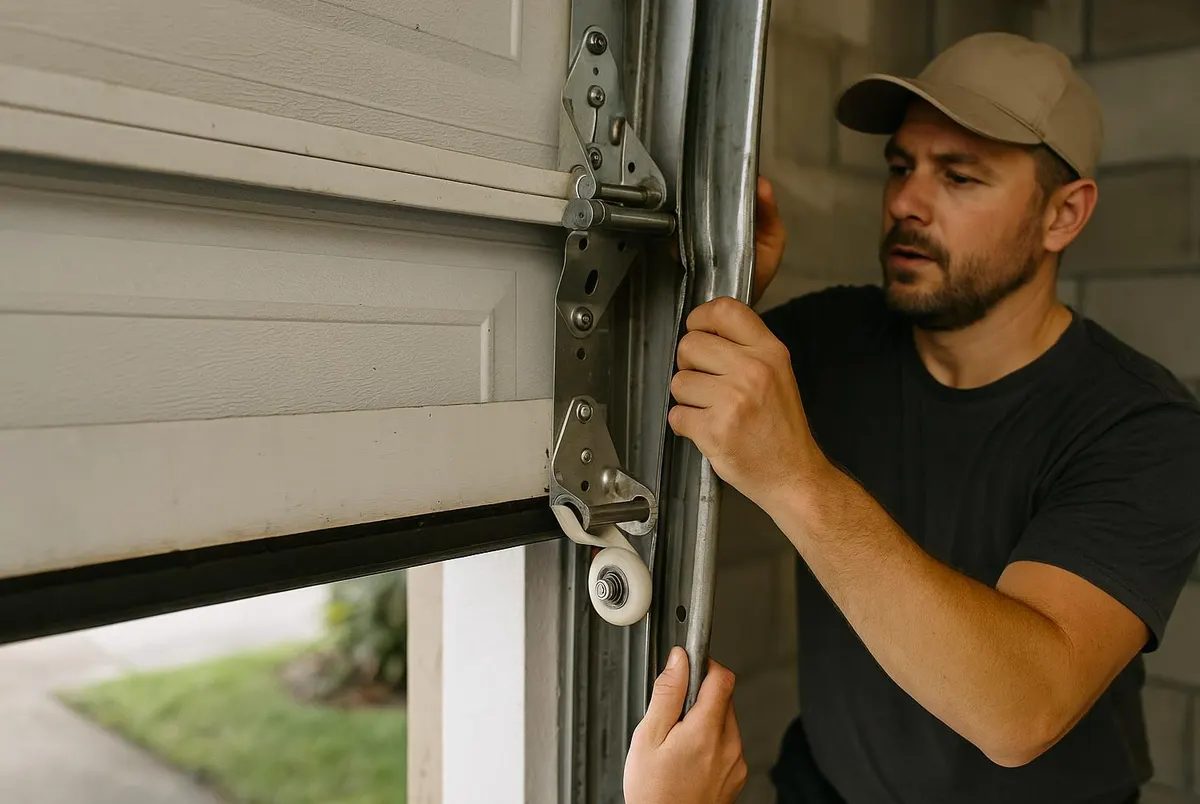
The Moment You Notice Something's Off
You hit the remote on your way out and the opener groans like it's hoisting a car instead of a door. Or maybe the door has started closing fast on one side and slow on the other, drifting a little crooked before it hits the floor. Some mornings it just sits there humming for a second before it moves at all. None of that is normal wear and tear — it's usually the first sign that your garage door is out of balance, and it's the opener that's paying the price.
What an Unbalanced Door Does to Your Opener
A properly balanced garage door should feel almost weightless once it's off the track of the springs doing their job. The springs — torsion or extension — are supposed to carry nearly all the door's weight, with the opener simply providing the push to move it along the track. When a spring weakens, stretches, or loses tension (which happens gradually with age, and faster with big temperature swings between a hot inland summer and a cool, rainy winter), the opener has to pick up the slack.
That means the motor works harder every single cycle. Over time this leads to stripped nylon drive gears, overheated motors, a frayed lift cable, and a logic board that starts misreading resistance as an obstruction — which is often why a door reverses for no obvious reason. An opener rated to last many years of normal use can burn out in a fraction of that time if it's been compensating for bad springs the whole way.
Tools You'll Need
- A sturdy step ladder
- Work gloves
- Safety glasses
- A helper, if possible (not required, but useful)
- Locking pliers or a C-clamp (for safety backup, not for forcing anything)
How to Test Garage Door Balance, Step by Step
- Close the door completely. Start from a fully closed, resting position so your results are consistent.
- Disconnect the opener. Pull the red release cord hanging from the trolley. This takes the motor out of the equation so you're testing the springs and door alone.
- Lift the door manually to about waist height. Use both hands, lift slowly, and pay attention to how much effort it takes.
- Let go and watch what happens. A balanced door will stay roughly in place, maybe drifting an inch or two. An unbalanced door will either slam down or shoot upward on its own.
- Repeat the test at the quarter-open and three-quarter-open positions. Some doors are balanced at one height and badly off at another, which points to a specific spring or cable issue rather than general wear.
- Reconnect the opener by pulling the release arm back toward the trolley until it clicks into place, then test the door with the remote to confirm normal operation.
What You Can Safely Check Yourself
Running the lift test, listening for grinding or straining, and doing a visual check for a visibly stretched or gapped torsion spring (look for a gap opening up in the coil) are all fine for a homeowner to do. If the door moves smoothly and holds its position at every height, you're in good shape.
What Needs a Technician
Adjusting spring tension, replacing a torsion spring, or re-tensioning cables is not a do-it-yourself job. Torsion springs are wound under extreme tension and the tools required to safely adjust them (winding bars, properly sized sockets) aren't something most garages have on hand, and a slip can cause serious injury. If your test shows the door sliding, dropping, or shooting up at any point, that's the signal to stop testing and call someone who adjusts springs for a living.
When to Call San Bernardino Garage Door
If your balance test turns up a door that won't hold its position, or if your opener has been sounding strained for weeks, it's worth having it looked at before the rainy season adds extra load from humidity and cold-stiffened hardware. San Bernardino Garage Door handles Spring Replacement and Garage Door Opener Service for homes throughout the area, and will check spring tension, cable condition, and track alignment together, since an imbalance is often caused by more than one worn part at once. We'll also check your opener's gears and force settings while we're there, so you're not replacing a motor that was only failing because of what the springs were doing to it.
If your garage door in San Bernardino, Highland, Redlands, Loma Linda, Colton, Rialto, Fontana, or Yucaipa isn't holding steady during a simple lift test, give San Bernardino Garage Door a call today and get it corrected before it costs you an opener.